

Medically reviewed by Michelle Forcier, MD, MPH
DIY HRT (do-it-yourself hormone replacement therapy) means taking hormones such as estrogen or testosterone without a prescription or ongoing medical supervision. Some transgender and nonbinary people use DIY HRT because gender-affirming healthcare is too expensive, unavailable where they live, difficult to access, or otherwise out of reach.
When possible, FOLX recommends getting hormone therapy (HRT) with support from a knowledgeable healthcare provider and obtaining medications from a licensed pharmacy. A clinician can help determine appropriate medication(s), route of administration, and dosing strategies might best suit your needs. In addition to getting a legal prescription, safety mechanisms also ensure that what you think you are taking is in fact , what you are putting in your body, without additional contaminants or unreliable dosing. Medically managed HRT also allows your clinician to order and interpret blood tests, identify possible medication interactions or side effects, and adjust treatment based on your medical history, side effects, goals and how your body responds.
But people do use DIY hormones. If you're currently self-managing HRT—or considering it—you deserve accurate, nonjudgmental information about the potential risks and ways to reduce them. If you are using DIY HRT- it is a really good idea to share this information with your FOLX clinician. No judgement! Understanding your experience will help us help you form a realistic and safe plan for how to best understand how to keep safe and we can hopefully get you a more reliable and safer method to achieve your gender goals.
Here’s what to know about DIY HRT and harm reduction.
What is DIY HRT?
DIY HRT, sometimes called self-managed HRT or self-medicated HRT, generally is used to mean taking gender-affirming hormones without a prescription or without a healthcare provider overseeing treatment.
For transfeminine people, this may involve taking some version of estrogen. There are different versions with different safety profiles! People sometimes add medications that reduce or block the effects of testosterone on skin and hair. For transmasculine people, DIY HRT may involve an androgen, most commonly testosterone.
People access DIY hormones in different ways. Someone might continue medication from an old prescription after losing access to care - check expiration dates as we don’t recommend using expired medications. They may also borrow or use prescription medication obtained from another person. This is actually illegal under federal and state laws and considered unlawful possession of a controlled substance - even if no money changes hands. Both parties can face criminal penalties. Some people also purchase hormones from an online source which is also generally considered illegal. These situations don't all carry the same risks. One important consideration is whether you can verify what substance you're actually taking, its strength or concentration, potential contaminants and where it came from. It is not possible to identify through physical appearance if an illicit medication has been cut or contaminated.
Is DIY HRT safe?
DIY HRT carries additional risks compared with HRT prescribed and monitored by a knowledgeable healthcare provider. The hormones themselves aren't necessarily the biggest source of additional risk. The problem is often the uncertainty that comes with taking medication without reliable prescribing, pharmacy verification, lab monitoring, or medical support.
With DIY hormones, you may not know:
- whether the medication contains what the label says
- whether the dose or concentration is accurate
- whether it was manufactured and stored safely and not expired
- whether the medication is appropriate given your health history
- whether it interacts with other medications you're taking
- whether your hormone levels are much higher or lower than expected
- whether changes in your health require adjusting your treatment
Gender-affirming hormone therapy is generally considered safe when appropriately prescribed and monitored. Working with a clinician adds safeguards that are difficult to replicate entirely on your own.
Why does FOLX recommend working with a clinician for HRT?
A gender-affirming healthcare provider can help you find an HRT regimen that reflects your body, your health, and your transition goals rather than relying on someone else's regimen or general information from the internet. The decision to get medically prescribed HRT ensures a more reliable and safer plan for affirmation.
Clinician-supported HRT can include:
- reviewing your health history and current medications
- discussing your goals for estrogen or testosterone therapy
- choosing an appropriate medication, dose, and route
- ordering and interpreting HRT blood tests when appropriate
- monitoring potential side effects and health changes
- adjusting your treatment over time and according to changing needs
- discussing fertility, contraception, sexual health, and preventive care when relevant
There isn't one universal “correct” dose of estrogen or testosterone. Two people taking the same dose can have very different hormone levels and physical responses.
That individualized support and guidance is one of the biggest advantages of working with a healthcare provider.
What are the risks of DIY HRT?
The specific risks depend on which hormones and other medications you're taking, your dose, your route of administration, your medical history, and the source of your medication.
Some important risks to understand include:
Unverified or counterfeit medications
Hormones obtained outside regulated pharmacy systems may not contain what they claim. The medication could contain a different amount of the active ingredient, another substance, or contaminants.
Getting medication from a licensed pharmacy provides substantially greater assurance about the medication's identity, strength, sterility, and storage.
Taking too much estrogen or testosterone
Taking more hormones does not necessarily make transition-related changes happen faster.
Once hormone levels are in an appropriate range, higher levels don't reliably produce faster or more dramatic results and may increase side effects or health risks. There are only so many receptors on specific hormone sensitive cells…too little or too much is not good care. You want to hit a “sweet spot” between the amount of hormone and levels that are not too low and cause problems versus levels that are too high and also cause problems.
This is also why copying someone else's HRT dose isn't a reliable way to determine your own. People can have significantly different hormone levels while taking the same dose.
Missing health changes that would show up in blood tests
Depending on the medications you're taking and your individual health history, a clinician may recommend monitoring hormone levels and other laboratory markers.
For example, testosterone can increase red blood cell production. Certain medications sometimes used alongside estrogen can affect potassium or kidney function. Usually these metabolic and blood changes are not terrifically risky, but it is recommended to follow certain labs to screen for problems or risk.
Without appropriate monitoring, those changes may be harder to identify or not identified until there is a more serious problem.
Risks from injecting hormones
Injectable estrogen or testosterone introduces additional risks related to access to sterile single use injection supplies, effective injection technique, and preventing infection.
Using contaminated injectable medication or reusing or sharing injection equipment can substantially increase those risks. Needle sharing has been shown to increase certain disease risks such as HIV and hepatitis.
Harm reduction for DIY HRT
If you're currently taking DIY hormones and can't access clinician-supported HRT right now, there are still ways to reduce some of the risks.
1. Know what medication you're taking
When possible, know the exact medication, concentration, dose, route, and source.
If it appears that the medication was actually dispensed by a licensed pharmacy, this offers greater assurance about what you're taking than medication from an unknown or unregulated source. However, you cannot be certain if these are actually the pills that are currently in the bottle.
Be particularly cautious with injectable products because contamination can introduce bacteria and viruses or other substances directly into the body.
2. Don't assume more HRT means faster results
Taking higher doses of estrogen or testosterone doesn't necessarily accelerate the changes you're looking for.
It can, however, increase your exposure to side effects or other risks. Certain estrogens are more risky than others for things like blood clots, pulmonary emboli and strokes. Certain routes and doses may be more risky than other routes and doses as well.
3. Get HRT blood tests if you can
Even if you're self-managing your hormones, blood tests can provide useful information about how much HRT you might need as an individual with your own unique metabolism, responses or side effects, and whether or not there is room to adjust the dose. Levels sometimes help us adjust medications, and still know that we are doing it effectively, safely..
Exactly which labs are appropriate depends on your medications and health history. A healthcare provider can help determine which tests you need, when to get them, and how to interpret the results. Certain health factors put people at risk for more problems or a serious adverse event including: older age, cardiovascular diseases such as high blood pressure, high cholesterol, diabetes, and smoking (both tobacco and vaping). Prior history of certain conditions related to the blood, the liver, the kidney, and mental health can also impact hormone safety.
If you see a healthcare provider, tell them what hormones or other medications you're taking, how much you're taking, how often you take them, and when you last took them. That context can be important for interpreting your lab results. Make sure they have your complete health history to look at other interactions and or risks.
While a provider might counsel you on the risks of DIY HRT, they can still provide you with helpful information, recommendations about what to consider and watch for, and be a safe place to ask more questions or for help. Providers may not recommend DIY HRT, but we still can improve your care if or when we are involved, including ordering lab work, looking at side effects and interactions, even if you’re getting hormones outside of the healthcare system.
4. Use sterile injection supplies every time
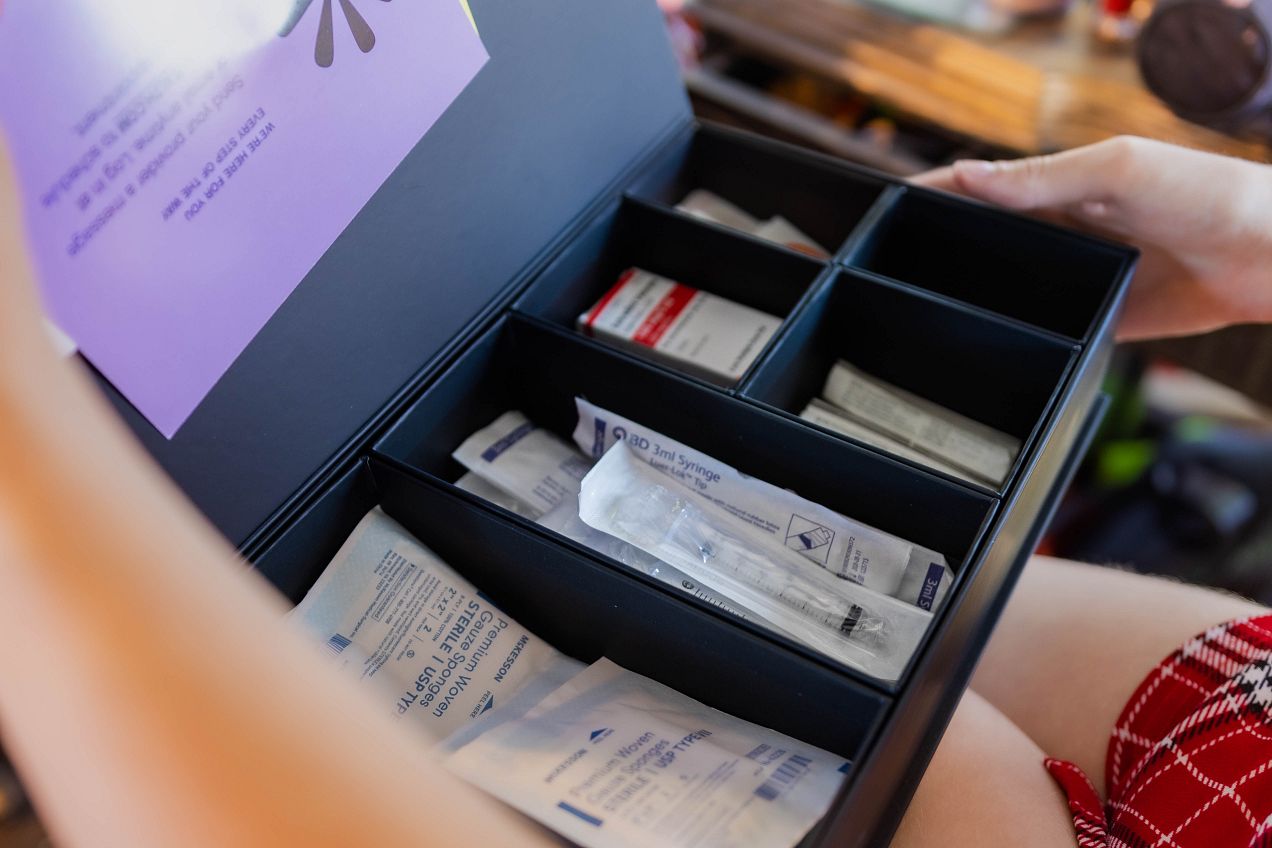
If you're injecting estrogen or testosterone, use a new, sterile needle and syringe for every injection. Never share injection equipment.
Wash your hands, clean the injection site, and dispose of used needles immediately in an appropriate sharps container. If you don’t have an FDA-cleared sharps container, the FDA says you can use a heavy-duty plastic household container—such as a laundry detergent bottle—that is puncture-resistant, leak-resistant, stable, and has a tight-fitting lid. Learn how to safely make and use an alternative sharps container, and check the disposal rules for your state before throwing away a full container.
If you're unsure about your injection technique, a clinician, pharmacist, or syringe-services program may be able to teach you safer injection practices. We have training videos and resources in our library and community platform.
Seek medical care if an injection site becomes increasingly red, hot, swollen, painful, or starts draining pus, particularly if you develop a fever or feel sick. If you have shared a needle or medication with someone you don’t know well and develop symptoms of a viral infection (fever, rashes, body aches, fatigue, etc) it is important to get checked for HIV, hepatitis, and other needle born infections.
5. Tell healthcare providers what you're taking
If you seek medical care for any reason, sharing that you're taking estrogen, testosterone, or other medications can help your provider make informed decisions about your care.
If you're transitioning from DIY HRT to prescribed HRT, you shouldn't pretend you're starting from zero. Tell your provider what you've been taking, how much, how often, how you've been taking it, and when you last took it.
It’s worth repeating: While a provider might counsel you on the risk of DIY HRT, and may express concern and worry about the safety, risks, and legality of this practice, the provider should not communicate a moral judgement on the practice. But know, in the end, we want you to get the "good stuff" - HRT that you can trust and know is safe and reliable when it is prescribed. At FOLX, we "get it" - sometimes decisions are based on many and complex factors. In fact, if that is the route you elect or need to choose, you can still talk with us about how to help manage these less known factors more safely.
Can you get blood tests if you're doing DIY HRT?
You may be able to access blood testing even if you're currently self-managing your hormones.
However, getting a lab result and knowing what it means aren't necessarily the same thing. Appropriate testing depends on the medications or even health supplements you're using, your health history, how often you forget to take your medications, and the timing of your medication relative to the blood draw, among other factors. All labs are not the same and there is great variation in what comes out for lab numbers and interpretations. These are even more complex when interpreting HRT labs.
Working with a healthcare provider can help you determine which labs are appropriate and interpret the results in the context of your overall health and transition goals.
What if I'm already taking DIY estrogen or testosterone?
You can still seek gender-affirming medical care if you've already started hormones on your own.
Be as specific as you can about:
- which medications you're taking
- your current dose
- how often you take them
- whether you're taking pills, injections, patches, gels, or another formulation
- when you last took your medication
- how long you've been taking it
- any other medications or supplements you're using
If you have the medication or its packaging, that information may also be helpful.
A knowledgeable gender-affirming provider can use this information along with your health history and, when appropriate, lab testing to help determine what makes sense going forward.
Do I need to stop DIY HRT before seeing a clinician?
Don't assume that you need to stop taking hormones before asking a healthcare provider for help.
Abruptly changing medications without understanding your individual situation isn't necessarily safer. Instead, tell your provider exactly what you're taking and ask them how to transition safely to clinician-supported care.
The goal should be to understand where you are now and create an appropriate plan going forward.
When should I get medical help while taking HRT?
Most expected effects of gender-affirming hormone therapy happen gradually. Sudden or severe symptoms shouldn't automatically be assumed to be a normal effect of HRT.
Seek urgent medical attention for symptoms such as:
- chest pain
- sudden shortness of breath and difficulty breathing
- coughing up blood
- sudden weakness or numbness or changes in sensory and movement abilities
- difficulty speaking or changes in vision
- a severe allergic reaction
- signs of a serious infection after an injection or chronic ongoing infections
- other severe, sudden, or potentially life-threatening symptoms
Tell the healthcare provider what medications you're taking

